Hi Cezar,

I built this whole thing for you and the ZYNT team. Scroll to find out why.

Signal scan

We ran scan on ZYNT.

Five things anyone can see about ZYNT from the outside, and what I would do about them in the first thirty days.

Favour Yusuf  ·  July 2026
Signal scan

Five things we found ahead of your London launch.

Congratulations on the quarter, by the way.

Signal 01  ·  Expansion

London is next.

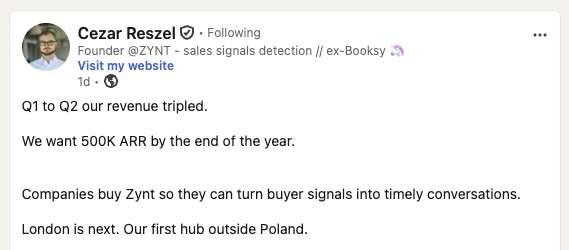
You announced that revenue tripled from Q1 to Q2, that you are going for 500K ARR by the end of the year, and that London will be the first hub outside Poland.

Everything here looks at that move, because the things that got ZYNT this far in Warsaw do not automatically travel with you.
Warsaw · working London · cold start ZYNT
LinkedIn post announcing tripled revenue, a 500K ARR target, and London as the first hub outside Poland.
Signal 02  ·  Audience

Everyone who finds your site is already in Poland.

Similarweb puts all of ZYNT's web traffic in Poland, and none of it in the United Kingdom.

That is normal for a company growing through its founder's network. It does mean London opens with nobody arriving on their own.

Share of web traffic by country

Similarweb  ·  June 2026
Poland
0%
United Kingdom
0%
Signal 03  ·  The ground in London

Someone already owns the search results there.

Cognism is headquartered in Richmond and ranks nineteenth in UK digital marketing. When a British buyer goes looking for a tool like yours, Cognism is who they find.

These three sell to the same person you do. Common Room is roughly one funding stage ahead of you.

Monthly web traffic, all sources

Similarweb  ·  June 2026  ·  visits per month
ZYNT Pre-seed, Warsaw
under 20,000
UserGems Series A
40,873
Common Room 51 to 200 staff
101,400
Cognism Richmond, UK
270,800
Signal 04  ·  AI answers

Ask an assistant for buying-signal tools and it names these ten.

CiteMatrix tracks which brands ChatGPT, Claude, Gemini and Perplexity actually name for sales-intelligence questions. ZYNT does not appear anywhere in the top sixteen.

This is a content problem rather than a product one. An assistant can only recommend what somebody has published in a place it can read.

Brands named for buying-signal questions

CiteMatrix  ·  30 June 2026
Apollo 82.9 ZoomInfo 69.5 Cognism 64.8 Clay 50.9 Salesloft Outreach Gong Clari HubSpot Salesforce ZYNT not listed
Signal 05  ·  The asset you already have

You have already written the piece a British buyer needs.

Your mid-market page lists the registers your team watches, and Companies House, the UK register, is the first one on that list.

The issue is not the writing, it is where the writing lives. A product page converts somebody who already found you, so it brings almost nobody new in.

getzynt.com/who-its-for/mid-market
On the product page
"A new foreign subsidiary in Companies House (UK), a US Secretary of State register, the Handelsregister (Germany), KvK (Netherlands), or Bolagsverket (Sweden)."
getzynt.com/blog
On the blog

This is the whole blog. Two posts, both from launch week, and neither one mentions a register.

  • Why Your GTM Strategy Fails Before the First EmailPaweł Brzózka  ·  29 April 2026
  • What Are Buying Signals in B2B Sales?Cezary Reszel  ·  22 April 2026
What the launch needs Before London

Ahead of the UK launch, three things need to exist.

Everything above is a symptom of the same thing, which is that ZYNT is discoverable in Poland and almost nowhere else.

These are the three gaps I would want closed before a London hub has anything to land on.

01

A way to be found by people who have never heard of you

In Warsaw your network does this job, and the numbers say it does it well. London has no equivalent yet, so something has to reach the buyers who were never going to be introduced to you.

02

A claim on the words British buyers actually search

Cognism currently answers those searches, and they answer them from Richmond. You need pages that show up for the same questions in the market you are entering.

03

A presence inside the answers assistants give

More buyers now build a shortlist by asking an assistant before they open a search engine. Assistants can only name what somebody has published, so this one follows directly from the second.

How I would build it First thirty days

Four pieces that close those three gaps.

Each one takes something ZYNT already knows and turns it into a page that a stranger can land on. I have marked which of the three needs each piece is doing the work for.

Week one Needs 02 & 03

Signal-based selling in CEE and the EU

Apollo owns the global version of this term with a single page, so competing for it directly would be a long fight. The regional version is still unclaimed, and it happens to describe what you actually do.

Everything else links back to this piece.
Week two Needs 01 & 02

How to read a Companies House filing as a buying signal

This is the UK version of what your mid-market page already knows, written as an article rather than a product page. I have outlined the whole thing below.

Aimed straight at the London market.
Week three Need 01

The four-year clock

Asseco held the ZUS contract, the cycle turned, and Comarch won it. Anybody tracking the contract dates had roughly a year of warning before it happened.

Shows the product working without pitching it.
Week four Needs 01 & 03

EU regulatory deadlines as buying signals

The AI Act, NIS2, DORA and CSRD all come with dates attached. Compliance vendors write about the obligation, and almost nobody writes about what those dates do to a buying cycle.

Brings in a much larger audience.
The writing Week two, drafted

The second piece, section by section.

Describing an article is easy, so I would rather show you the shape of a real one.

This is the week two piece as it would actually run. The headline it would carry, then every section heading a reader scrolls past, with a note on what each one is doing.

Working headline

The UK Accounts Worth Calling This Quarter Are Already on Public Record

Every British company is legally required to publish the moves it makes just before it starts spending. Read those filings properly and your target list stops being a guess.

About 1,800 words For a sales lead, not an accountant Serves needs 01 and 02
Section 01

Your team is already ignoring the best list they have

Opens on a frustration the reader already recognises, which is a quarter spent calling accounts that were never going to buy. The turn is that the accounts which were going to buy announced it in public, and nobody on the team was reading.

Section 02

The five filings worth knowing

Incorporations, an overseas company opening a UK establishment, director appointments, registered charges and confirmation statements. Each one is explained as what it tells a seller about the account, never as what it means to an accountant.

Section 03

What each filing tells you about budget

Maps every filing to the commercial event sitting behind it. A new UK establishment usually means a market entry with money already committed, a director appointment in a new function means a team is being built around a problem, and a registered charge means the financing has just landed.

Section 04

When to call, and when you are already too late

The section that decides whether any of this actually shows up in revenue. Each filing type has a window where the account is still deciding, and this covers how long that window runs, what a first call sounds like inside it, and why the same account is a waste of a dial once it has closed.

Section 05

The same reading in Germany, the Netherlands and Sweden

Handelsregister, KvK and Bolagsverket all publish the same category of disclosure, so the method carries straight across. If a team sells into more than one European country, this is the section that turns a British tactic into a plan for the whole territory.

Section 06

What this costs you in selling hours

Honest arithmetic on watching five registers properly, every week, in five languages, and what those hours would have produced if the reps had spent them on calls instead. ZYNT arrives here as the thing that removes the work, at the end of the piece rather than as the reason for it.

Say the word and I will have the first piece drafted within a week.

You get to read the actual writing before you decide anything bigger. If it is worth carrying on, this is what the rest of it looks like.

  • The rest of the quarter, including the German and Dutch versions of the week two piece
  • A calendar built around the event-intelligence launch, so the feature arrives into an audience
  • The written pieces themselves, starting with the pillar
  • A lead magnet the cluster feeds, listing one register to watch per market
  • A visibility baseline, so the effect on search and AI answers is measured rather than assumed